Quick answer: You can use a Japanese floor mattress in a carpeted bedroom, but leaving a cotton shikibuton directly on carpet for long periods is a poor setup. Moisture can collect where the futon meets the floor. For regular use, consider a manufacturer-approved breathable underlayment or low slatted base, lift the futon to air it, and check both the mattress and carpet for dampness. No underlay makes a damp room mold-proof.
A Japanese floor mattress can be a clever way to make a bedroom more flexible. You get a low-profile bed at night and, with a foldable shikibuton, more usable floor space during the day. But many American bedrooms have wall-to-wall carpet rather than traditional Japanese tatami flooring. That changes the practical questions: What goes underneath? Is a thick carpet a problem? And how do you keep the underside dry?
This guide focuses on the setup that matters: a Japanese floor mattress on carpet. You’ll learn how to assess your room, compare support options, and build an easy routine that helps prevent moisture problems without overselling any one product.
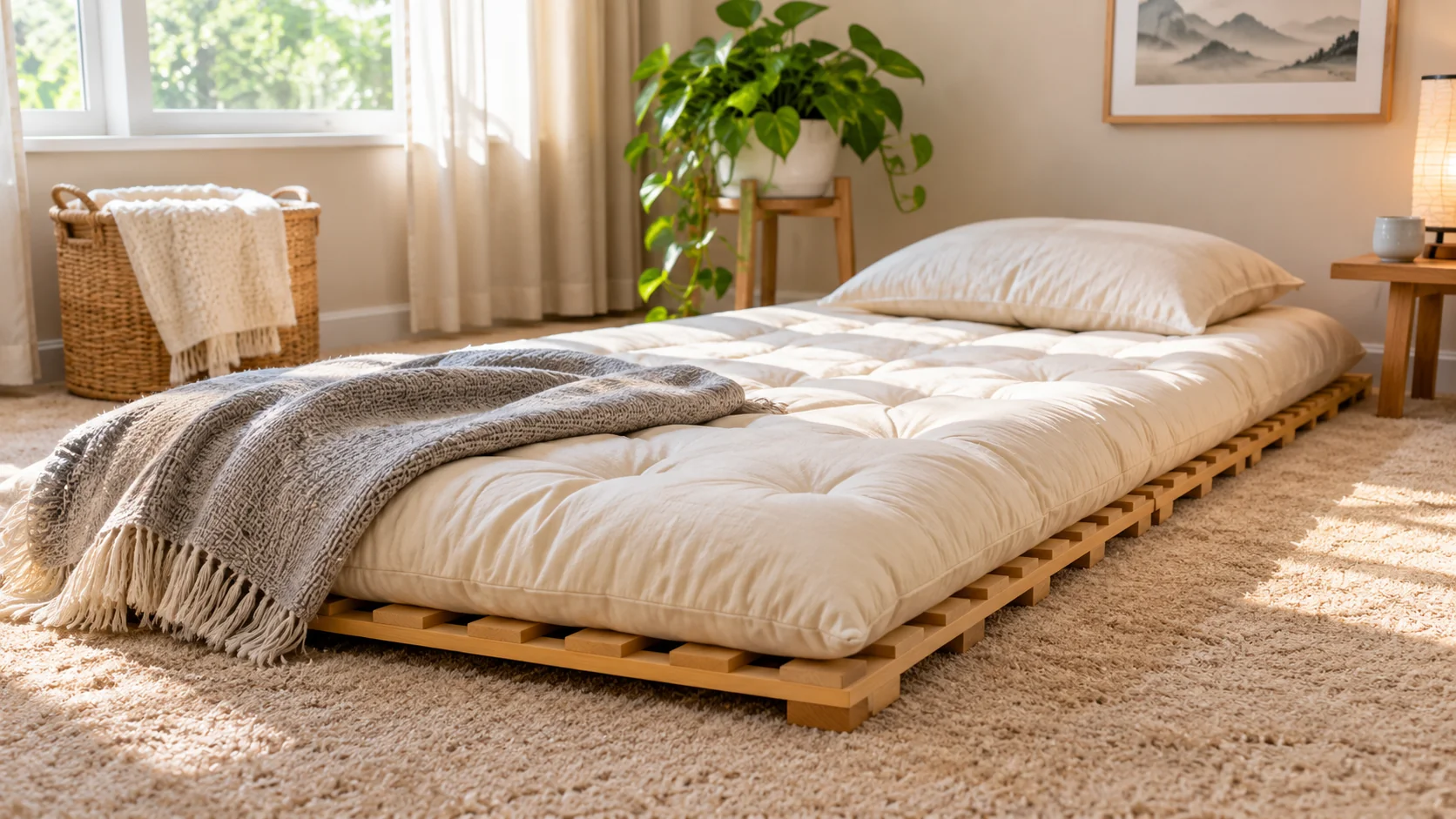
Can You Put a Japanese Floor Mattress Directly on Carpet?
Occasionally, possibly; as a permanent unattended setup, it is not recommended. Always follow the instructions for your particular futon. Specialist maker J-Life International says that its shikifutons can sit directly on the floor, but recommends adding tatami or a similar underlayment because trapped sleeping moisture may encourage mold. Futons From Japan goes further and advises against placing its shikibutons directly on carpet, wood, or laminate without a barrier. The difference matters: construction and care requirements vary between products.
Carpet is not automatically wet, and putting a futon on it does not guarantee mold. The concern is that the bottom of a mattress is harder to inspect and dry when it stays in continuous contact with an absorbent surface. A carpet pad, concrete subfloor, damp climate, or limited ventilation can make the situation harder to manage.
Low-pile carpet versus thick carpet
Low-pile carpet provides a flatter surface than plush carpet, but it still does not create a ventilation gap. Thick or shaggy carpet may compress unevenly under a heavy mattress or base. Neither type should be treated as a substitute for a breathable support system when the mattress maker recommends one.
Carpet over concrete versus wood
The subfloor matters as much as the carpet surface. A basement or ground-floor room with recurring condensation, leaks, or a musty smell needs a moisture fix before you add floor bedding. Never use a futon to cover a known damp patch. The U.S. Environmental Protection Agency (EPA) emphasizes moisture control as the foundation of mold prevention.
Why Can Japanese Floor Mattresses Develop Mold?
During sleep, bedding encounters moisture from the sleeper and surrounding room. A cotton-filled shikibuton needs opportunities to release that moisture. If the underside remains pressed against a surface and cannot dry, dampness may accumulate. Mold becomes more likely when moisture persists; it is not unique to Japanese futons.
Watch for a persistently damp underside, a musty odor, visible spotting, condensation nearby, or a wet-feeling carpet. If a mattress or carpet has suspected mold growth, do not simply cover the area with another mat and continue sleeping there. Address the moisture source and obtain suitable cleaning or replacement advice; porous, mold-contaminated materials may be difficult to restore.
What Should You Put Under a Japanese Floor Mattress on Carpet?
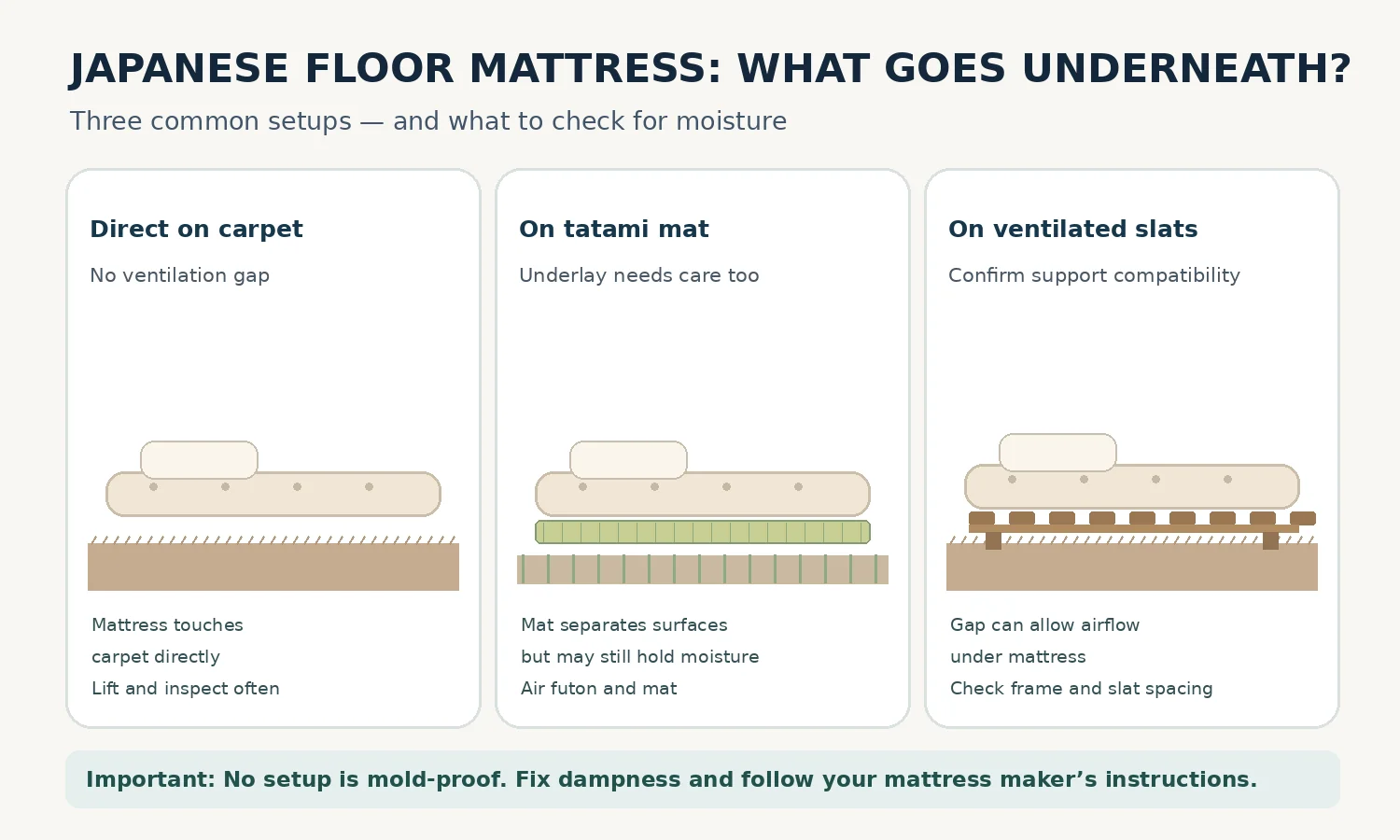
The right option depends on the futon’s material, your floor, available space, and whether you sleep on it every night. There is no universally safe underlay for all mattresses or all rooms.
| Setup | Potential advantage | Important limitation | Best suited to |
|---|---|---|---|
| Directly on carpet | Simple and inexpensive | Little to no air gap; must be lifted and checked | Short-term use only when the manufacturer permits it |
| Tatami or tatami-style mat | Traditional firm underlayer | Not every mat is ventilated; natural materials can also hold moisture | Owners following specific futon-maker guidance |
| Low slatted platform | Creates separation and potential airflow | Slat spacing, load rating, and mattress support must be compatible | More permanent floor-bed setups |
| Breathable underlayment | May add a separation layer | Performance depends on design and maintenance; no mold guarantee | Low-profile setups with manufacturer-approved products |
| Raised bed frame | Elevates the sleeping surface farther from carpet | Not all thin futons suit widely spaced slats | Rooms where floor-level care is impractical |
Option 1: Tatami mats
Tatami is the traditional companion to a Japanese futon, and J-Life recommends tatami or a similar underlayment for its cotton shikifutons. Yet the word “tatami” does not mean waterproof or mold-proof. Some tatami products absorb moisture and need their own airing and care. Choose a mat compatible with your bedding and check both sides regularly.
Option 2: A low, ventilated slatted base
A well-designed slatted platform can keep the futon slightly above the carpet and allow air to move underneath. Check that the platform remains stable on your specific carpet, has sufficient support across its surface, and meets the mattress manufacturer’s specifications. A decorative pallet or improvised slats are not automatically suitable.
Option 3: A purpose-made breathable underlay
Some mattress accessories are designed to separate bedding from a floor surface. Look for transparent material and care specifications, compatibility with your mattress, and clear information about how the product itself should be dried. Avoid assuming that a thin impermeable plastic sheet solves the problem; it can keep moisture from dispersing.
How to Set Up a Japanese Floor Mattress on Carpet
- Inspect the room. Look and smell for water damage, condensation, mustiness, or damp carpet. Fix moisture problems before placing bedding.
- Read the futon’s care instructions. Check its permitted surfaces, whether it needs a support base, and how often it should be aired.
- Choose the underlayer. If recommended by the maker, select a compatible tatami mat, breathable support, or slatted base. Make sure everything sits securely.
- Check room humidity. A basic hygrometer can help you monitor conditions. EPA guidance generally recommends indoor humidity around 30–50%, where practical.
- Set a daily lift-and-air routine. In the morning, expose the underside and allow moisture to dissipate before folding or storing, following the manufacturer’s guidance.
- Inspect underneath. Feel the floor and mattress for unexpected dampness and investigate any odor or visible spotting promptly.
How to Prevent Moisture and Mold
Air the mattress consistently
Traditional cotton futons are designed to be lifted, folded, or aired regularly. Do not leave one lying flat in exactly the same position for weeks. Some manufacturers recommend allowing warmth and moisture to dissipate before storage rather than folding a still-damp futon immediately. Always use the instructions for your specific filling and cover.
Control the room’s humidity
According to the EPA, indoor relative humidity should ideally stay around 30–50%, where feasible. Use ventilation, air conditioning, or a dehumidifier as appropriate for the room and outdoor conditions. A hygrometer tells you more than guessing by how warm or cool the room feels. A dry room is not a replacement for airing the futon, but it helps address one factor in mold growth.
Keep the floor and underlay clean and dry
Vacuum carpet regularly, following the carpet-maker’s instructions. If you wet-clean carpet, wait until it is fully dry before replacing the futon or its base. Inspect any tatami or underlay too; moving moisture from the futon to a different absorbent mat does not eliminate it.
Store only after airing
If you fold your floor mattress during the day, give it time to release trapped heat and moisture first. Store it in a dry, ventilated location, not a damp closet or airtight bag unless the manufacturer explicitly approves that storage method.
Japanese Floor Mattress on Carpet vs Hardwood vs Tatami
| Floor surface | Practical consideration | What to check |
|---|---|---|
| Carpet | Absorbent surface and underpad can hide dampness | Carpet dryness, underlay choice, daily lifting |
| Hardwood or laminate | Harder surface is easier to wipe, but a futon can still trap moisture against it | Surface finish, condensation, manufacturer support guidance |
| Tatami | Traditional bedding surface that also needs care | Mat construction, humidity, airing instructions |
| Slatted raised base | Provides potential airflow and separation | Stability, slat spacing, mattress compatibility |
None of these surfaces can compensate for a room with persistent leaks, condensation, or wet flooring. The best choice is the one that your mattress manufacturer supports and that you can realistically maintain.
When a Japanese Floor Mattress May Not Be the Right Fit
A floor mattress is not ideal for every household. Think twice if your bedroom is persistently damp, if lifting the mattress regularly is difficult, or if getting up from floor height is uncomfortable. A person who needs more cushioning or accessible bed height may prefer a conventional bed. The Japanese label also covers very different products: a traditional cotton shikibuton and a thick foam “floor mattress” may have different care requirements.
If your main reason for buying is a flexible guest bed, compare how much the product weighs, how it folds, where it will dry, and where it can be stored. A foldable mattress is not automatically a low-maintenance mattress.
Frequently Asked Questions
Can I put a Japanese futon directly on carpet?
Check the manufacturer’s instructions. Some brands permit floor placement but recommend an underlayment; others explicitly advise against direct contact with carpet. For nightly use, prioritize moisture control, regular airing, and a support arrangement compatible with your bedding.
Will a Japanese floor mattress get moldy?
Not necessarily. Mold risk increases when materials remain damp. Regular inspection, airing, moisture control, and suitable placement can reduce risk but cannot guarantee prevention, particularly in a room with leaks or damp carpet.
Do I need a tatami mat under a futon?
Not every manufacturer requires one. Tatami is a traditional option, but a compatible breathable base or other specified underlay may be acceptable. Tatami itself also needs care and should not be assumed to provide perfect ventilation.
How often should I air out a Japanese floor mattress?
Follow the maker’s care schedule. For a foldable cotton shikibuton used daily, make lifting and airing part of your routine, with further drying or rotation as specified. Inspect the underside more often if the room is humid.
Can I use a Japanese floor mattress every night?
Many shikibutons are designed for regular sleeping, but comfort, support, accessibility, and moisture management depend on the individual product and sleeper. Choose a product intended for nightly use and confirm its cleaning and floor-placement requirements.
Is carpet or hardwood better?
Neither surface removes the need to air the mattress. Carpet can conceal dampness within its fibers or pad; hard flooring can still trap moisture under bedding. The condition of the room and the mattress manufacturer’s instructions matter more than a simple “carpet versus wood” rule.
Can I put a Japanese floor mattress on a bed frame?
Possibly, if the frame’s support arrangement is compatible with the futon. Thin cotton bedding may need closer support than widely spaced slats provide. Check both the frame and mattress specifications before buying.
Final Verdict: Is Carpet Suitable for Your Futon?
Yes, a carpeted room can accommodate a Japanese floor mattress—but direct, long-term carpet contact is not the setup to assume is safe. Start with the manufacturer’s guidance, prevent any existing dampness, consider a suitably ventilated support layer, and make airing the bedding part of your daily routine. If you can’t keep the underside dry or accessible, a raised bed may be the wiser choice.
For a broader home-care routine, see our home maintenance checklist, which covers humidity and overlooked household upkeep tasks.
Sources and Further Reading
- J-Life International — Japanese bedding FAQ (underlayments and shikifuton care)
- Futons From Japan — FAQ (surface placement and airing)
- U.S. EPA — A Brief Guide to Mold, Moisture and Your Home (mold and humidity prevention)
- U.S. EPA — Care for Your Air (indoor humidity guidance)
Editorial note: This guide summarizes publicly available manufacturer and agency guidance; it is not a hands-on product test. Images are illustrative and do not certify a specific setup as mold-proof.